
Board Certified Vascular Surgeons

It is very important to choose board-certified vascular surgeons who have expertise in all aspects of the diagnosis and management of your circulation problems. Board-certified vascular surgeons have completed extensive training and national accreditation in the comprehensive management of circulation disorders. They are required to maintain ongoing education to ensure they can provide the most state of the art treatment to their patients.
All of the physicians at Savannah Vascular Institute are board-certified and have undergone additional fellowship training from accredited Vascular Surgery or Interventional Radiology centers of excellence throughout the world.
Spider Veins
Spider veins or telangiectasias are small varicose veins located just beneath the skin. They are a problem for millions of people. You are not alone in your desire to rid yourself of these painful and unsightly veins. They may be inherited from your parents and may worsen with weight gain, pregnancy or simply for no identifiable reason.
In many cases, spider veins are of a cosmetic concern only. In other cases, they may in fact be related to an underlying medical problem known as venous insufficiency or reflux (backwards flow of blood in the veins). In either situation, symptoms associated with spider veins range from itching or a dull ache to throbbing pain and bleeding.
Your physician will develop a treatment plan for your individual case. Spider veins can be successfully treated with injection sclerotherapy.
Sclerotherapy
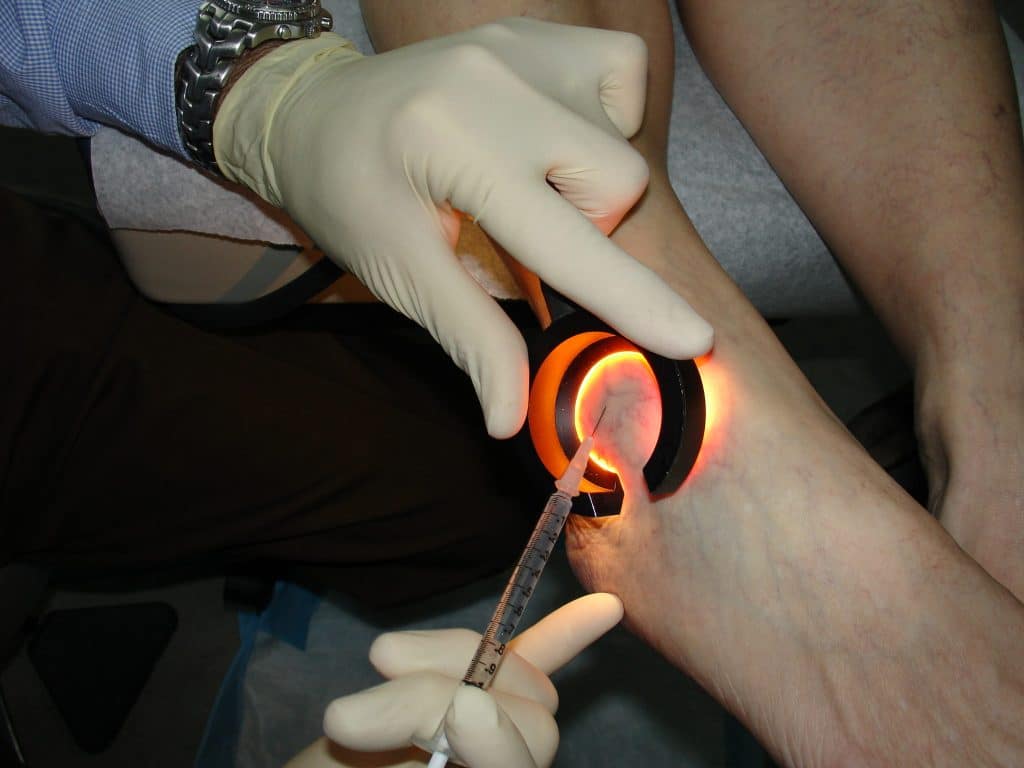
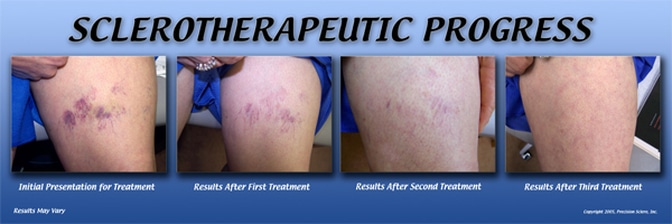
Spider veins can be successfully treated with injection sclerotherapy. Sclerotherapy is the most popular method of eliminating spider veins. This is the “gold standard” and is more effective and less expensive than lasers (for spider veins, not varicose veins). An FDA-approved medication called sotradecol is injected into the veins using very tiny needles.
This solution causes an irritation to the inner lining of the vein resulting in closure of the vein. The vein stops carrying blood and therefore disappears with time. The majority of people who have sclerotherapy performed have satisfying results and little discomfort.
Varicose Veins
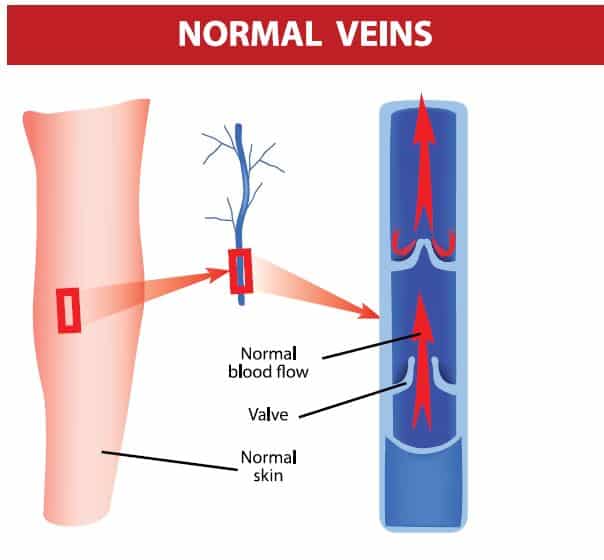
Incompetent faulty valves in your veins result in Reflux (downward, backwards blood flow in veins) and lead to varicose veins
Varicose veins are superficial veins that have enlarged due to increased pressure in your veins caused by incompetent, or leaking, valves that are much larger than spider veins. They are a problem for millions of adults. You are not alone in your desire to rid yourself of these unsightly and painful veins. You may have had them for years or they may have just recently become a problem for you.
Varicose veins may be inherited from your parents and may worsen with weight gain, pregnancy or may simply occur for no identifiable reason.

Varicose veins may cause an aching feeling in your legs or may result in pain, swelling, skin discoloration or even ulcers. They may be related to an underlying medical problem known as venous insufficiency or reflux (backwards blood flow in the veins).
The disease is typically progressive and can eventually involve the entire saphenous vein (the vein that runs under your skin along your calf and thigh) as well as many of its branches if it is not treated.
Your insurance company will usually cover treatment of your varicose veins if they cause significant symptoms and if you have attempted conservative treatment for 3-6 months sometime in the past without relief (elevation, compression stockings, exercise and weight control).

Varicose veins in the legs
Veins in your legs are tubes that carry blood from your feet toward your heart. One-way valves are located inside your veins and should only allow blood to flow up, out of your legs and back to your heart. When valves go bad for different reasons, blood flows backwards and builds up or pools in your leg veins. The backwards flow of blood in your veins is known as reflux and places excess pressure on the vein walls. This causes veins to expand and become varicose and can result in leg swelling, permanent skin changes and non-healing ulcers as pressure is transferred to the skin.
In the case of varicose veins (big bulging rope-like veins visible on the skin), they are often related to leaking valves in the Saphenous Vein (the vein which is just under the skin and runs along the inside of your calf and thigh).
Should an ultrasound confirm reflux in the saphenous system, a procedure called radiofrequency vein ablation or closure can be used to eliminate the underlying reflux by closing off the leaking vein which is the source of the problem.
Venous Reflux
Venous insufficiency and reflux (backwards flow of blood in veins) occurs in nearly 50% of adults to some degree and many suffer from pain, swelling and varicose veins. Complications include permanent darkening of the skin, bleeding, phlebitis (clots) and formation of non-healing ulcers and infection.

Insurance companies have recognized saphenous reflux and painful varicose veins to be medically necessary if you have attempted conservative treatment for 3-6 months in the past:
- compression stockings
- exercise
- weight control
- leg elevation
Varicose Vein Ablation/Closure Procedures

Your physician will develop a treatment plan for your individual case. Varicose veins caused by reflux in the superficial saphenous vein can be successfully treated with endovenous ablation. Lasers and radiofrequency ablation (high energy ultrasound) have been used safely for many different medical applications throughout the body. In recent years, small fibers have been used successfully to deliver heat energy to treat varicose veins. These methods allow your doctor to close off the diseased superficial vein that contains leaking valves, thus preventing any further reflux (backwards flow of blood) into your varicose veins.
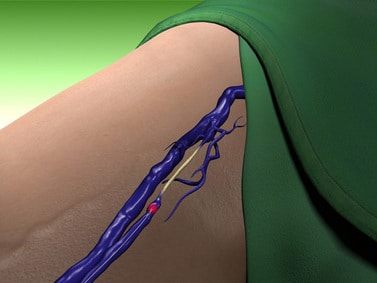
The procedure is usually performed in the doctor’s office with numbing medicine and a mild sedative, thus eliminating the need for hospitalization and general anesthesia. The physician will use ultrasound to assess and map the vein(s). A very small incision is made at the site and the physician inserts a sterile catheter through the skin and positions it within the abnormal vein using ultrasound guidance. The fiber or electrode tip is inserted through the catheter. A solution called Tumescent (a numbing medication mixture of lidocaine, saline, epinephrine) is administered at predetermined intervals into the skin along the thigh and over the vein. Minimal stinging may be experienced.
Tumescent is used to numb the tissue around the vein and protect it from the generated heat. As the physician gently pulls back the catheter the fiber uses high frequency radio waves to generate heat that seals the target vein. If Laser Ablation is used, the diseased vein is sealed using laser energy. Recovery is quick. Patients are encouraged to return to normal activities the day after the procedure. The vast majority of patients have very satisfying results and little discomfort.
Once you have decided to proceed with Varicose Vein ablation treatment, you will be asked to come to the office to view a video on the procedure, discuss pre-procedure guidelines, discuss consent and sedation if desired, review financial issues with insurance and be measured for new stockings if you need them. This visit usually takes about 30 minutes and any further questions will be answered.
Commonly Asked Questions
Varicose veins occur for a number of reasons including age, prior pregnancy, weight gain, hereditary factors and prolonged periods of standing.
- Spider veins or telangiectasias are small varicose veins located just beneath the skin. In many cases, spider veins are of a cosmetic concern only. In other cases, they may in fact be related to an underlying medical problem known as venous insufficiency or reflux (backwards flow of blood in the veins). In either situation, symptoms associated with spider veins range from itching or a dull ache to throbbing pain and bleeding.
- Varicose veins are superficial veins that have enlarged due to increased pressure in your veins caused by incompetent, or leaking, valves that are much larger than spider veins. Varicose veins may cause an aching feeling in your legs or may result in pain, swelling, skin discoloration or even ulcers. They may be related to an underlying medical problem known as venous insufficiency or reflux (backwards blood flow in the veins). The disease is typically progressive and can eventually involve the entire saphenous vein (the vein that runs under your skin along your calf and thigh) as well as many of its branches if it is not treated.
Initial evaluation is with one of our board-certified vascular physicians. Many patients require an ultrasound which is often performed at the same setting in our accredited vascular lab. Treatment options and alternatives are discussed at this visit. Most patients with bulging varicose veins can be treated with radiofrequency ablation. A catheter is inserted like an IV using numbing medicine. Some patients may require additional procedures to treat larger veins. Patients with spider veins are typically treated with sclerotherapy (tiny injections of a medication directly into the small spider veins).
Yes. Thousands of patients have demonstrated that this procedure is more effective than traditional vein stripping and successful in 90% of patients.
Energy is delivered to the inner walls of the vein causing the leaking, diseased vein to close off and not continue to leak blood into the varicose veins.
No. An incompetent saphenous vein is essentially a non-functioning vein and blood that would have flowed through the vein has already been diverted into other healthy veins to drain the leg.
No, this is an office procedure in most all patients and takes about 1 hour. Most patients opt for local anesthesia (lidocaine like at the dentist) combined with oral medication while others prefer anesthesia given in an IV if they choose not to be awake during the procedure.
Some patients are more sensitive than others but few really complain of significant pain during or after the procedure. Patients typically describe an aching, burning or pulling sensation.
We encourage walking the same day and return to normal activities the next day. You should delay strenuous exercise for one week.
You may still require sclerotherapy or tiny incisions to remove additional varicose veins after the laser procedure has closed off the leaking vein in your leg. We will also do an ultrasound several days after the procedure to check the status of the treated vein.
Both procedures are FDA-approved, non-surgical methods of treating varicose veins. They are very similar in terms of how you are treated and what you will experience. The results for both procedures are excellent and this becomes a physician preference. The main difference is in the type of energy delivered by the catheter. One procedure is not proven better than the other. Savannah Vascular prefers to use radiofrequency vein ablation.
